
De Quervain's Tenosynovitis
Dr. Peter Weil (GP), Claire Weil (RN)
4 min read
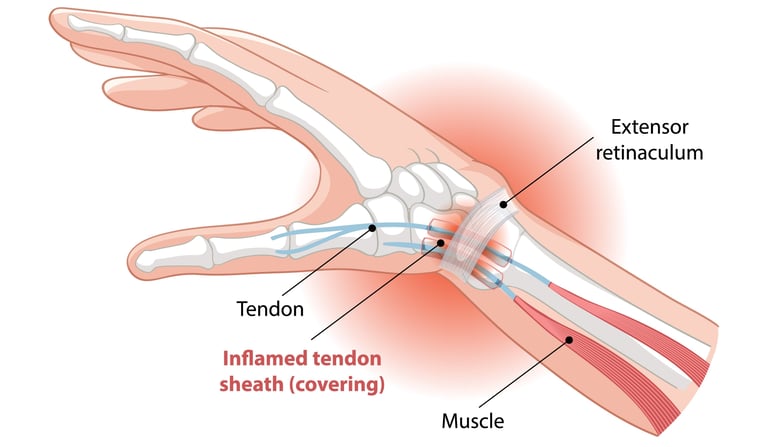
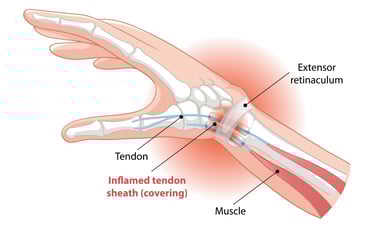
Wrist and thumb pain can be disruptive and persistent. One common cause is De Quervain's tenosynovitis, a condition that affects the tendons on the thumb side of your wrist.
These tendons help move your thumb, and when they become irritated or inflamed, it can cause significant pain with everyday activities like gripping, lifting, or turning your wrist.
This brief guide explains:
What causes this wrist and thumb pain
The options to treat it
How steroid injections can help — including how often they work and when they don't
What Is De Quervain's Tenosynovitis?
De Quervain's tenosynovitis occurs when two tendons on the thumb side of the wrist (the abductor pollicis longus and extensor pollicis brevis) become irritated or inflamed. These tendons run through a narrow tunnel, and when the tunnel lining (tenosynovium) swells, the tendons cannot glide smoothly.
Common symptoms are:
Pain on the thumb side of the wrist
Swelling near the base of the thumb
Pain when gripping, pinching, or turning the wrist
A catching or snapping sensation when moving the thumb
Difficulty with activities like opening jars, lifting babies, or using a keyboard
This condition is more common in new parents (from repetitive lifting), people who do repetitive hand movements at work, and following wrist injuries. Women are affected more often than men.
How Is It Diagnosed?
Diagnosis starts with talking about your symptoms and a physical exam. Your clinician may perform a test called Finkelstein's test, where you make a fist with your thumb inside your fingers and bend your wrist toward your little finger. If this causes sharp pain on the thumb side of the wrist, it suggests De Quervain's tenosynovitis. Sometimes ultrasound imaging is used to confirm the diagnosis or check for other problems, although it is generally not required.
What Are the Main Treatments?
Rest and Activity Modification - Avoiding or reducing activities that aggravate the pain is important to allow the tendons to settle. This might mean changing how you lift or grip objects.
Splinting - Wearing a thumb splint helps rest the tendons by limiting thumb and wrist movement. Splints are often worn during activities that trigger pain and sometimes at night.
Pain Relief and Anti-Inflammatory Medicines - Over-the-counter pain-relief medicines (like NSAIDs) can help reduce discomfort and inflammation, though they don't fix the underlying problem.
Physiotherapy and Exercises - Once the acute pain settles, gentle stretching and strengthening exercises can help restore function and prevent recurrence. Physiotherapists can provide specific exercises and advice.
Steroid (Corticosteroid) Injections - Steroid injections are used when conservative measures aren't providing enough relief or when pain is significantly affecting daily activities.
Surgery - Surgery is rarely needed, but may be considered if symptoms persist despite other treatments. The procedure involves opening the tight tunnel to give the tendons more space to move.
How Steroid Injections Can Help
A steroid, usually combined with a local anaesthetic, is injected into the tendon sheath on the thumb side of the wrist. The clinician uses anatomical landmarks to place the needle accurately into the affected area.
Steroids reduce inflammation around the tendons and within the tendon sheath. Many people experience significant pain relief, which can allow them to return to normal activities and participate more fully in rehabilitation exercises.
Research shows that steroid injections are quite effective for De Quervain's tenosynovitis. Studies suggest success rates of around 60-80%, with many people experiencing lasting relief after a single injection. Some people may need a second injection if symptoms return.
The injection typically provides relief within a few days to a week, and the benefit can last for months or even be permanent in some cases. Combining the injection with splinting and activity modification tends to improve outcomes.
In short, steroid injections can be very effective for De Quervain's tenosynovitis, offering many people substantial and sometimes long-lasting relief, though they don't work for everyone.
What to Expect After a Steroid Injection
After an injection:
You may get relief within a few days to a week
Maximum relief often occurs within 2–4 weeks
Relief may last several months or longer
Splinting is usually recommended for a few weeks after injection
Avoiding aggravating activities during recovery is important
Summary
De Quervain's tenosynovitis causes pain on the thumb side of the wrist from inflamed tendons.
Rest, splinting, and activity modification are important first-line treatments.
Steroid injections can provide significant relief for many people, with success rates of 60-80%.
Many people improve substantially with injection, but results vary. Injections should be used as part of a broader treatment plan.
If you are struggling with symptoms of wrist or thumb pain, you can contact us to discuss your needs, or book in directly for a consultation.
References
Peters-Veluthamaningal C, van der Windt DA, Winters JC, Meyboom-de Jong B. Corticosteroid injection for de Quervain's tenosynovitis. Cochrane Database of Systematic Reviews. 2009;Issue 3:CD005616.
Ashurst JV, Turco DA, Lieb BE. Tenosynovitis caused by texting: an emerging disease. Journal of the American Osteopathic Association. 2010;110(5):294-296.
Witt J, Pess G, Gelberman RH. Treatment of de Quervain tenosynovitis. A prospective study of the results of injection of steroids and immobilization in a splint. Journal of Bone and Joint Surgery. 1991;73(2):219-222.
Richie CA, Briner WW. Corticosteroid injection for treatment of de Quervain's tenosynovitis: a pooled quantitative literature evaluation. Journal of the American Board of Family Practice. 2003;16(2):102-106.
Cavaleri R, Schabrun SM, Te M, Chipchase LS. Hand therapy versus corticosteroid injections in the treatment of de Quervain's disease: a systematic review and meta-analysis. Journal of Hand Therapy. 2016;29(1):3-11.
This information is for educational purposes only and is not a substitute for professional medical advice, diagnosis, or treatment. Always seek the advice of your health provider with any questions you may have regarding a medical condition.
Privacy and GDPR Policy | Terms and Conditions for Website Use & Cookies
Dr. Peter Weil, MBChB, BSc, MRCGP (2007).
Registered with the Information Commissioners Office - ZB780390